Justice!
Written by Mark Edwards on September 10, 2026
Justice
First Amendment Rights Are Critical in a Democracy
What would America’s founding fathers think if they could sit behind a one-way courtroom window and witness today’s arguments over freedom, protest, justice and liberty?
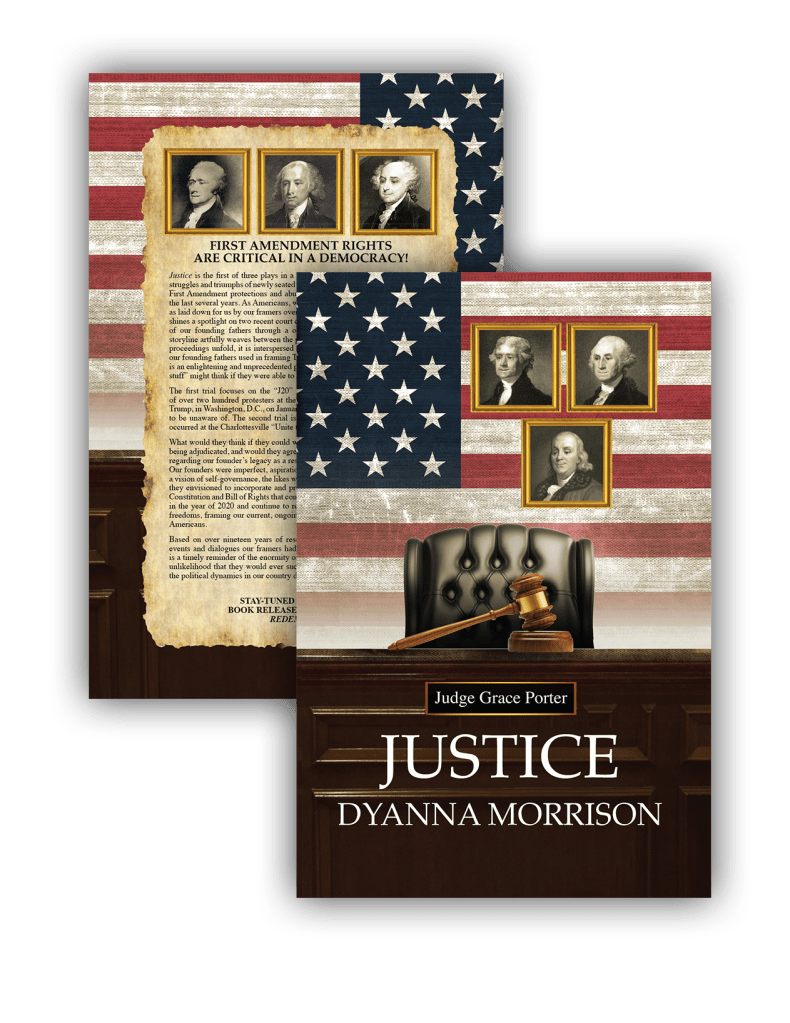
What If The Founders Could Watch Us Now?
Justice is the first work in Dyanna Morrison’s Justice Trilogy, following newly seated Judge Grace Porter as she faces courtroom cases involving some of America’s most fiercely debated constitutional freedoms.
Watching proceedings through a one-way window are George Washington, Thomas Jefferson, Alexander Hamilton, John Adams, James Madison and Benjamin Franklin.
Their presence gives Morrison an unusual dramatic device: modern America is forced to confront the men involved in framing the Constitution and Bill of Rights.
First Amendment Rights
Justice focuses on the protections and possible abuses surrounding the First Amendment across two emotionally charged trials.
The cases bring questions of freedom of speech, peaceful assembly, public safety, equality, liberty and civic responsibility directly into Judge Grace Porter’s courtroom.
Freedom of Speech
How far should freedom of expression extend when the speech involved is offensive, inflammatory or deeply unpopular?
The Bigger Question
When does protecting public order begin restricting the freedoms the Constitution was designed to defend?
The J20 Trial
The first case draws on the arrests surrounding protests during Donald Trump’s inauguration in Washington, D.C. on January 20, 2017.
More than 200 people were arrested during the demonstrations, and the events provide Morrison with the basis for an examination of protest, policing, public order and constitutional freedom.
Charlottesville And The Limits Of Free Speech
The second case is loosely inspired by the events surrounding the Unite the Right rally in Charlottesville, Virginia, on August 11 and 12, 2017.
Here Morrison moves into even more difficult territory, examining racism, extremism, public safety, protest and constitutional protection.
The Founding Fathers Are Watching
The theatrical device that gives Justice its identity is Morrison’s decision to place America’s founders behind a one-way window overlooking the courtroom.
Washington, Jefferson, Hamilton, Adams, Madison and Franklin listen to the modern arguments and discuss the ideas behind the Constitution and Bill of Rights.
Morrison draws heavily on documented historical language and writings, allowing the founders themselves to become active participants in the drama.
Would They Agree?
Would the founders recognise the way their words are interpreted in the twenty-first century?
Does It Matter?
Should the original intentions of people living more than two centuries ago determine how constitutional freedoms operate today?
More Than Twenty Years Of Research
Dyanna Morrison began researching America’s founding fathers, the Constitution and the Bill of Rights in 2001.
The idea itself began in the late 1990s following conversations with a close family friend.
One question stayed with her:
That question became the foundation of the Justice Trilogy.
America’s Difficult History
Justice also engages with the contradiction between the ideals of liberty contained in America’s founding documents and the continuing existence of slavery during the founding era.
Morrison asks audiences to consider the founders within the context of the eighteenth century while still confronting the consequences of slavery, racial inequality and the long struggle for civil rights.
Judge Grace Porter’s Response
Within the drama, Judge Porter condemns racism, religious intolerance and terrorism while considering the obligations that accompany constitutional liberty.
The play therefore becomes not merely a discussion about what America was intended to be, but about what it still hopes to become.
Then Comes Liberty
Liberty, the second title in the series, moves the constitutional argument towards the Second Amendment and the debate surrounding gun ownership.
The play centres around a hypothetical trial involving the president of the NRA following a mass shooting at a pro-gun rally.
Constitutional Rights
How should the Second Amendment be interpreted in a society dramatically different from the America in which it was written?
Public Safety
Can gun-control legislation and constitutional protection coexist through compromise?
The American Experiment Continues
One of Morrison’s central themes is that democracy is not something a nation simply creates once and then leaves untouched.
Every generation has to debate the freedoms, principles and institutions it inherits.
Democracy requires:
- Debate
- Disagreement
- Participation
- Responsibility
- Ultimately, compromise

Meet The Author: Dyanna Morrison
Dyanna Morrison was born and raised in Upstate New York and has spent much of her adult life in Providence, Rhode Island, and San Diego, California.
She holds both a Bachelor’s and Master’s Degree in Business Administration and has spent much of her professional career working in account management and nonprofit talent acquisition.
The premise of the Justice Trilogy first entered her thoughts in the late 1990s and eventually led to more than twenty years of research into America’s founding fathers, the Constitution and the Bill of Rights.
Following the political events of 2016 and 2017, Morrison returned to her earlier research and began developing Justice again with renewed determination.
Another Side Of Dyanna Morrison
Morrison’s work is not restricted to politics, history and constitutional law.
She also turned her poem For the Love of Buddy into a family and children’s picture book.
She has also completed For the Love of Winston, inspired by more than fifteen years spent with her tuxedo cat.
Discover Justice
Enter Judge Grace Porter’s courtroom and discover a story where modern America comes face to face with the people who helped create its founding principles.
Editorial Note
This feature discusses political, historical and constitutional themes explored in Justice and Liberty. Views and interpretations attributed to Dyanna Morrison are presented as the author’s perspective. Questions surrounding America’s founders, slavery, constitutional interpretation and modern political events remain subjects of historical, legal and political debate.
Discover More Authors On UK Talk Radio
UK Talk Radio introduces listeners to independent writers, thought-provoking books and interesting voices you may not hear anywhere else.
Listen online or ask Alexa to “play UK Talk Radio.”
UK Talk Radio
— Independent voices. Interesting conversations. Books worth discovering.
Justice
The Justice Trilogy
By Dyanna Morrison
A courtroom drama that puts America’s founding fathers behind the glass and asks what they would make of the freedoms they helped create.
Danny Copper Reviews
There is an immediately intriguing idea at the heart of Justice by Dyanna Morrison.
What would the people who helped frame the United States Constitution and Bill of Rights make of the way those freedoms are interpreted in America today?
It is the sort of premise that could easily have become either a dry history lesson or a heavy-handed political argument.
Morrison largely avoids both.
A Courtroom Drama With History Looking Over Its Shoulder
The founding fathers are not simply decorative historical figures dropped into a modern story.
Their arguments, writings and documented ideas are woven into the drama, allowing the constitutional debates of America’s founding generation to sit alongside contemporary disputes over freedom of speech, peaceful assembly, public safety and individual liberty.
Judge Grace Porter Gives The Story Its Human Centre
For all the constitutional discussion, Grace Porter prevents the work from becoming merely an intellectual exercise.
She has to make decisions.
Historical figures can argue about principles. Commentators can debate interpretations. The judge sitting in the courtroom must eventually decide how those principles apply to actual people and actual circumstances.
Real Events Give Justice Additional Weight
The two cases at the centre of the work draw inspiration from highly contentious events in recent American history.
One relates to arrests surrounding protests during Donald Trump’s presidential inauguration in Washington on January 20, 2017.
The second draws upon events surrounding the Unite the Right rally in Charlottesville later that year.
The Question
Where does peaceful protest end and public disorder begin?
The Bigger Question
When does intervention designed to protect society begin restricting constitutional freedom?
The Founding Fathers Are More Than A Gimmick
The strongest aspect of the work is Morrison’s decision to allow America’s founders to witness modern constitutional disputes.
The temptation with historical figures is to turn them into convenient mouthpieces for present-day opinions.
Justice becomes more interesting when it resists doing that.
Instead, the founders argue among themselves.
Not Quite A Conventional Novel
Readers should understand what Justice is before picking it up.
This is a stage play presented in book form rather than a conventional courtroom novel.
That gives it a different rhythm.
Arguments arrive quickly. Ideas collide. Characters challenge one another.
A Book That Wants An Argument
Some books want the reader to disappear into another world.
Justice wants the reader to start an argument at the dinner table.
That is not a criticism.
In fact, it may be one of its greatest strengths.
Who Will Enjoy Justice?
- Readers interested in American history
- Readers interested in constitutional law
- Fans of courtroom drama
- Readers interested in political theatre
- Anyone fascinated by the First Amendment
Recognition For Justice
Justice has received finalist recognition in several literary competitions in the Performing Arts category.
- Book Excellence Awards
- National Indie Excellence Awards
- International Book Awards
- Best Book Awards
That recognition makes sense because Justice sits somewhere between literature, history, courtroom drama and theatre.
Danny Copper’s Verdict
Justice is one of those works built around a question that sounds simple until you begin trying to answer it.
What would America’s founders think of the country their Constitution ultimately produced?
Dyanna Morrison does not attempt to provide a neat answer.
Instead, she puts the founders in the room, gives them something to argue about and allows the modern courtroom to become a testing ground for principles written more than two centuries earlier.
The courtroom sections give the story momentum while the historical discussions provide its intellectual substance.
Justice is provocative without depending upon sensationalism.
UK Talk Radio Rating
5 out of 5
Danny Copper
UK Talk Radio Chief Book Correspondent
About The Book
Title: Justice
Series: The Justice Trilogy
Author: Dyanna Morrison
Format: Paperback
Justice combines courtroom drama, constitutional history and political theatre as Judge Grace Porter presides over First Amendment cases while America’s founding fathers observe and debate the freedoms they helped establish.
Editorial Note
This review discusses themes and interpretations presented in Justice. Historical, constitutional and political questions surrounding the events and people discussed remain subjects of academic, legal and political debate.
Discover More Authors On UK Talk Radio
UK Talk Radio introduces you to independent writers, memorable stories and books worth discovering.
Listen online or ask Alexa to “play UK Talk Radio.”
See Also This Book Featured The Best Books Chart Of 2026 From Uk Talk Radio
UK Talk Radio
— Home of new music, authors and independent creativity.